How to Prepare Your Body Before a Phuket Muay Thai Camp: 8-Week Pre-Trip Plan
How to prepare your body for a Phuket Muay Thai camp — cardio, strength, flexibility, and heat tips with an 8-week pre-trip training plan.
You've booked your camp. You have six, eight, or twelve weeks before you arrive in Phuket. What you do with that time makes a meaningful difference to how quickly you adapt, how much you learn, and how much you enjoy the experience. This guide covers the pre-trip preparation that actually matters — and what you can safely ignore.
Why Pre-Trip Preparation Matters
The first week at a Muay Thai camp involves a significant physical shock: twice-daily training, heat, new movement patterns, and accumulated fatigue. Arriving already reasonably fit shortens the adaptation period and means you start making real technical progress earlier. Arriving undertrained means most of the first week is spent just surviving.
You don't need to arrive as an athlete — camps are designed to work with all fitness levels, including complete beginners. But arriving with a baseline of cardiovascular fitness, some leg strength, and basic flexibility means day three feels manageable rather than catastrophic. The difference between "sore but functional" and "can't walk down stairs" in week one often comes down to what you did in the eight weeks before the flight.
Cardiovascular Base: The Most Important Preparation
Muay Thai is primarily a cardiovascular sport. A session involves continuous effort — skipping, running, technique drilling, padwork — with only brief rest periods. If your aerobic base is poor, you'll spend energy just breathing rather than on technique.
What to Do
Running: The most directly transferable preparation. Start with 20–30 minutes three times per week and build to 40–50 minutes by the week before departure. Muay Thai camps typically start with a 3–5km run at 6 AM — arriving comfortable at this distance removes one significant friction point from the first week.
Skipping rope: If you can access a jump rope, 10–15 minutes of continuous skipping is one of the best specific preparations for Muay Thai training. It builds the calf endurance, coordination, and cardio base that directly transfers to camp warm-ups. Start with two-minute rounds with rest, build to five-minute rounds.
HIIT or interval training: Two sessions per week of interval work (30 seconds hard, 30 seconds rest, repeated for 15–20 minutes) trains the anaerobic system and prepares the body for the high-intensity rounds of padwork and bag work. This can be done on a bike, rowing machine, or with bodyweight circuits.
You don't need to run a 5km in under 25 minutes. You need to be able to run continuously for 30–40 minutes without stopping. That's the honest target.
Leg Strength: Protect Your Joints
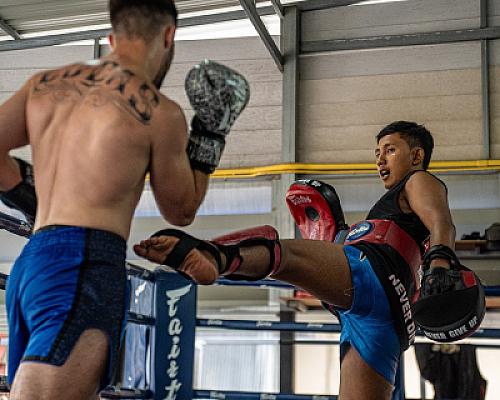
Kicking is the most physically demanding technique in Muay Thai, and it places significant load on the hip flexors, glutes, hamstrings, and knee joint. Arriving with stronger legs means generating more power sooner and reducing the injury risk from the repetitive kicking volume.
What to Do
Squats: Bodyweight or goblet squats, three sets of 15–20 two to three times per week. Focus on depth and control rather than adding weight. The explosive hip extension of a Muay Thai kick requires the same muscle patterns as a deep squat.
Lunges: Walking lunges and reverse lunges build the single-leg stability that Muay Thai footwork demands. Three sets of 12 per leg twice per week.
Hip flexor work: The hip flexors are heavily loaded in kicking. Standing knee raises (10 per leg, controlled and deliberate) and leg swings are sufficient preparation. More importantly, stretch the hip flexors regularly — tight hip flexors limit kick height and create lower back strain when kicking at volume.
The S&C for Muay Thai guide covers what to add once you're at camp — but the pre-trip basics above are enough to arrive ready.
Flexibility: Reduce Injury Risk
Muay Thai requires meaningful hip flexibility for kicking and clinch work. Arriving inflexible means either limiting kick height (which limits technique development) or pushing range of motion before it's ready (which causes injury).
What to Do
Fifteen minutes of stretching daily, focused on:
- Hip flexors: Low lunge hold, 60 seconds each side
- Hamstrings: Standing or seated forward fold, 60 seconds
- Groin/adductors: Wide squat hold or butterfly stretch, 60 seconds
- Hip rotators: Figure-four stretch or pigeon pose, 60 seconds each side
You don't need yoga-level flexibility. You need to be able to kick to waist height without straining, and to sit in a low guard stance without your hips fighting against you. Six weeks of daily stretching is enough to achieve this if you're starting from a stiff baseline.
The full flexibility and mobility guide covers ongoing work once you're training — the pre-trip version above is the minimal effective dose.
Upper Body: Guard Endurance
Holding a Muay Thai guard — elbows raised, hands protecting the face — for extended periods is surprisingly tiring for people who don't train. The shoulders and upper back fatigue quickly if they're not conditioned to this position.
What to Do
Push-ups: Three sets of 15–20 daily, focused on form. Builds the shoulder stability and chest endurance that guard work requires.
Plank variations: Two to three minutes of plank work per day. Core stability is important for generating power in strikes and absorbing body kicks.
Shoulder circles and band work: Light resistance band pull-aparts and shoulder rotations keep the rotator cuff healthy under the volume of punching a camp demands.
Heavy bench press and overhead pressing are less important than the endurance-focused work above. Muay Thai doesn't need a big bench — it needs shoulders that stay up for 90 minutes.
Heat Acclimatisation
Phuket's heat and humidity affect performance significantly, and full acclimatisation takes 10–14 days of exposure. You can't fully replicate this before arriving, but you can reduce the shock.
Train in heat when possible: Do some of your cardio sessions in the warmest part of the day. If you have access to a sauna, 15–20 minutes post-workout two to three times per week in the weeks before departure initiates some of the physiological adaptations (increased plasma volume, better sweat response) that make heat training more efficient.
Reduce air conditioning dependence: If you work in a heavily air-conditioned environment, spending more time at ambient temperature in the weeks before the trip reduces the acclimatisation shock on arrival.
Hydration habits: Start the hydration habits before you leave. Arriving in Phuket already in the habit of drinking water consistently throughout the day means you're less likely to dehydrate badly in the first few days.
What Not to Do
Don't start sparring at home for the first time right before the trip: Beginning contact sparring two weeks before a major trip risks the exact injuries — facial cuts, bruised ribs, sprained fingers — that could sideline you on arrival. If you've never sparred, wait until you're at camp with qualified supervision.
Don't overtrain the week before departure: The final week before travel should be reduced volume — two light sessions rather than five hard ones. Arriving fatigued is worse than arriving slightly undertrained. Your body needs to be fresh and recovered for the shock of camp training.
Don't obsess over technique videos: Watching Muay Thai YouTube for hours and trying to self-teach at home produces bad habits that trainers then need to correct. Better to arrive with a clean slate and good physical conditioning than with technical habits that need undoing.
A Simple 8-Week Pre-Trip Plan
Weeks 1–3: Build the aerobic base. Three runs per week (25–35 min), two strength sessions (squats, lunges, push-ups, plank), daily stretching (15 min). Keep intensity moderate.
Weeks 4–6: Add interval work. Two HIIT sessions replace one of the moderate runs. Introduce skipping rope if you have access. Strength volume stays the same.
Weeks 7–8: Maintain rather than build. Three runs (30–40 min), one HIIT session, two strength sessions. Daily stretching continues. Reduce to two light sessions in the final week.
This plan takes roughly 45–60 minutes per session and requires no gym membership — running, bodyweight exercises, and a jump rope are sufficient.
Practical Preparation
Physical preparation is only part of the pre-trip work. Before you leave:
- Book your camp and confirm the package details — see the Phuket camps guide for what to look for
- Pack your training kit — the full packing checklist covers everything you need
- Sort health insurance that covers sports injuries — standard travel insurance often excludes combat sports
- Research which camps suit your level — the beginner gyms guide covers which facilities are most accessible for first-timers
The physical work pays off from day one. The logistics preparation means day one starts smoothly rather than chaotically. Both matter.