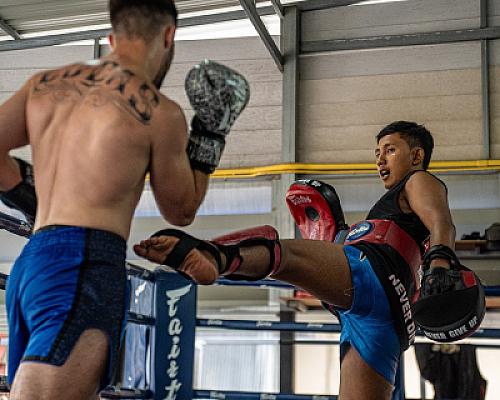
The Muay Thai Mental Game: Toughness, Motivation, and How to Handle Hard Training
How to build mental toughness for Muay Thai training in Phuket — handling bad sessions, staying motivated through a long camp, and managing fear.
The physical demands of Muay Thai are obvious. The mental demands are less discussed but arguably more determining — particularly in a camp context where you're training every day, accumulating fatigue, and pushing through difficulty without the option of an easy week. How you think about hard training shapes how much you get from it. This guide covers the mental skills that make the difference between a camp that transforms you and one you just survive.
The Mental Architecture of Hard Training
Muay Thai training tests specific mental qualities that are different from the ones tested by ordinary gym work. The primary ones:
Tolerance of sustained discomfort: Training in 33°C heat, tired from the morning session, in the third round of padwork when your arms are heavy and your legs feel like they're made of concrete. This is a learnable tolerance, not an innate one — but you have to engage with it rather than avoid it to develop it.
Present-moment focus: Muay Thai's technical demands require full attention. The combination you're drilling, the distance you're managing, the opening you're setting up. Athletes who train while mentally somewhere else — replaying the last bad session, anxious about the next sparring round — learn slower and exhaust faster than those who stay fully present.
Equanimity with failure: Every Muay Thai session contains failure. A combination that doesn't land, a defensive read that's wrong, a sparring round that goes badly. The relationship you develop with these failures — whether they destabilise you or just inform you — determines both learning speed and enjoyment.
Motivation management: Twice-daily training for weeks requires active motivation management. The initial enthusiasm of arriving in Phuket sustains roughly five days. After that, something more durable has to carry the training.
Dealing with Bad Sessions
Every training trip includes sessions that go badly. The padwork felt clumsy. The sparring was frustrating. The combination you've been drilling all week fell apart under pressure. These sessions feel disproportionately significant in the moment and matter less than they seem.
A few observations that experienced practitioners hold about bad sessions:
Bad sessions often precede breakthroughs. The pattern of "struggle, then suddenly it clicks" is well-documented in skill acquisition. When a technique is being consolidated into muscle memory, performance temporarily deteriorates before it improves. A session where your left kick felt worse than it did two weeks ago may be the session right before it becomes automatic.
Fatigue is cumulative and affects perception. Arriving at day 10 of a camp tired, slightly dehydrated, and sore, your assessment of how well a technique is working will be more negative than it would be fresh. This is a measurement problem, not a training problem. Separating "I trained badly today" from "I am not improving" requires recognising when fatigue is distorting the signal.
Trainers see more than you do. You feel the session from the inside — the awkwardness, the effort, the things that went wrong. Your trainer sees the external movement. On days when you feel like you're regressing, ask your trainer for feedback. Frequently, the session you experienced as poor looked better than it felt.
Staying Motivated Through a Long Camp
The motivation crisis typically hits around week two for most camp trainees. The novelty has worn off, the soreness has accumulated, the end is not yet in sight. This is predictable and manageable.
Goal Anchoring
Before the trip, write down why you're doing this. Not a vague answer ("get fit," "try Muay Thai") but a specific one: "I want to be able to do three full rounds of padwork without my technique falling apart under fatigue." "I want to spar for the first time by week three." "I want to lose 5kg and have something to show for the month."
Re-reading this when motivation dips reconnects you to the reason you booked the trip. The reason was real enough to get you there — it's still real on day 12 when it's 3 PM, your legs are sore, and the afternoon session starts in an hour.
Process Focus Over Outcome Focus
Focusing on outcomes — weight lost, technique achieved, rounds won in sparring — creates motivational fragility. When the outcome doesn't materialise on the expected timeline, motivation collapses. Focusing on the process — being fully present in every padwork round, listening to feedback and implementing it, showing up for every session — creates a motivational structure that doesn't depend on moment-to-moment outcomes.
Thai trainers tend to reinforce this implicitly. They're not particularly interested in how hard you tried to land the technique — they're interested in whether you did the right thing with your hips. The process is the product.
Celebrate Small Wins
Progress in Muay Thai is granular. You won't notice it day-to-day, but you'll notice it week-to-week if you track the right things. On the last day of each week, identify one specific thing you can do that you couldn't do at the start of the week. Not "I'm better at Muay Thai" — something concrete: "My teep is landing consistently at the right distance now." "I stayed composed in sparring when I got hit." These small wins compound and are the honest evidence that the training is working.
Managing Fear in Sparring
Fear before sparring is universal — experienced fighters have it, beginners have it, it's a normal response to consensual physical contact. Managing it is a learnable skill.
The fear usually exceeds the reality. Most sparring at Phuket camps — particularly beginner sparring — is far less physically threatening than it feels in anticipation. Experienced partners control their power; the fear is mostly about the unfamiliar nature of the situation, not the actual contact level.
Focus narrows fear. Fear thrives in broad anticipation ("what if something goes wrong?"). Specific focus narrows it. Before the round starts, pick one thing to focus on: "I'm going to use the teep every time my partner advances." A specific technical goal occupies the attention that fear would otherwise fill.
Breathing is the intervention. Fear produces breath-holding, which worsens performance and amplifies anxiety. Before the round: three slow, deliberate exhales. During the round: exhale audibly on every technique. The breath is both a performance tool and a state-management tool simultaneously.
The Long-Term Mental Adaptation
One of the consistently reported effects of sustained Muay Thai training is a general shift in the relationship with difficulty. Athletes who complete a month-long camp describe a changed response to challenges outside training — work stress, physical discomfort, frustrating situations — that they attribute to the mental conditioning of training.
The mechanism is probably simple: you've spent weeks demonstrating to yourself that you can function effectively in sustained discomfort, that bad moments pass, and that consistent effort produces results even when progress isn't visible day-to-day. These aren't just lessons about Muay Thai.
This mental adaptation is most available to people who engage with the difficulty rather than managing around it. The training trips that produce it are the ones where you stayed in the room when it was hard, went to the afternoon session when you didn't feel like it, and asked your trainer to push you rather than give you an easy session on day nine. The physical results fade eventually. The mental ones tend to stick.
See the 30-day camp guide for the week-by-week progression of what to expect mentally, the first week guide for navigating the initial mental challenges specifically, and the consistency guide for maintaining the mental habits that training builds when you return home.