Training for a Marathon in Thailand: Heat, Routes and Local Races
Training for a marathon in Thailand is genuinely different from training in a temperate climate, and most articles on marathon preparation do not address the heat and humidity side adequately. If you are in Thailand for
Training for a marathon in Thailand is genuinely different from training in a temperate climate, and most articles on marathon preparation do not address the heat and humidity side adequately. If you are in Thailand for several months and want to build toward a marathon, or if you are entering a Thai race while on an extended stay, this guide covers what actually changes about your preparation.
\n\nHeat Adaptation: The First Four Weeks
\n\nRunning in Thailand when you are not acclimatised is significantly harder than it should be. Most runners who arrive from Europe, Australia or North America and immediately try to maintain their training pace find themselves slowing down dramatically and wondering if they have lost fitness. They have not. The body takes roughly two to four weeks to adapt to training in high heat and humidity, during which cardiac output for a given pace increases, plasma volume expands, and sweating becomes more efficient.
\n\nDuring this adaptation period, run by effort and heart rate rather than pace. Expecting to hold 5:00/km in Bangkok in March when you are used to training in 15-degree weather is not realistic for the first few weeks. A heart rate monitor helps here: run at the same heart rate you would target at home and accept whatever pace that produces. It will improve.
\n\nPractical heat adaptation strategies that actually work: run early (before 7am if possible, before 8am as a minimum in any coastal city). Run in the shade where it is available. Cut your long runs shorter in the first two weeks and build back up as your body adjusts. Do not try to replicate your home training volume immediately on arrival.
\n\nRunning Routes: Phuket
\n\nPhuket has some excellent running options if you know where to go. Nai Harn Lake in the south of the island has a paved loop of approximately 3km around the lake. It is shaded on some sections, flat, and one of the most popular running spots among expat runners on the island. Early morning, the path is busy with Thai and foreign runners alike. For longer runs, combine the lake loop with the adjacent roads toward Windmill Viewpoint (the climb is significant, about 80 metres of elevation gain in under 1km).
\n\nThe Laguna area in Bang Tao on the north-west coast has a running path through the resort zone that extends for several kilometres. This is the same area used for the Laguna Phuket Triathlon course. The surface is mostly paved and the canopy provides partial shade. It is flatter than the south of the island and better suited to tempo work.
\n\nFor trail running, Khao Phra Taew National Park in the north of the island has trail routes through rainforest. The trails are technical and humid, but the shade is genuine. These are not beginner running routes but are worth knowing for experienced trail runners on longer stays.
\n\nRunning Routes: Bangkok
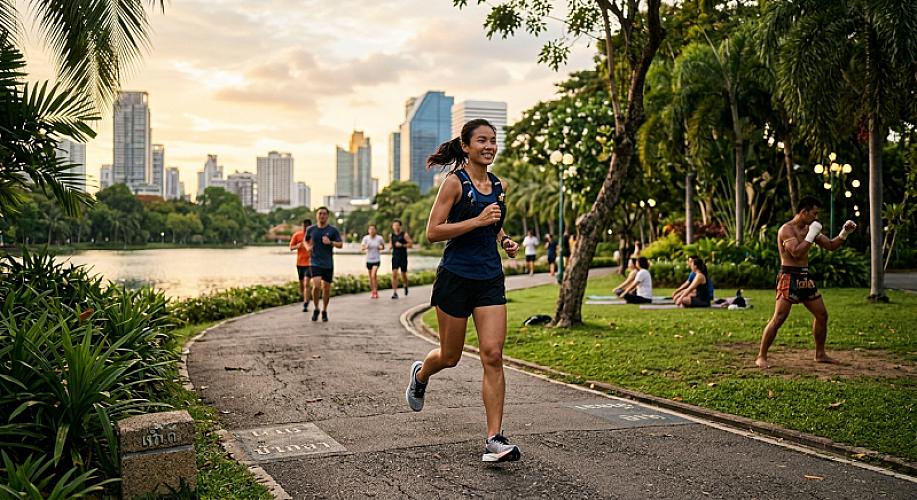
\n\nBangkok's two main running parks are Lumpini Park (central, near Silom) and Benjakitti Park (Sukhumvit area, near MRT Queen Sirikit). Lumpini has a 2.5km perimeter loop; Benjakitti has a 1.5km inner loop and a longer outer path. Both are lit at night, which makes evening running viable when the heat has dropped slightly.
\n\nFor longer training runs in Bangkok, connecting the two parks via the canal-side paths in the Yannawa area is possible (though requires navigation) and adds up to around 12-15km of connected path. The Bang Sue Cycling Lane in the north of the city offers a long flat route that is accessible by MRT.
\n\nRunning on Bangkok streets outside of parks is generally unpleasant due to uneven footpaths, traffic, and air quality. Save your long runs for park routes and use streets only for short warm-up or cool-down segments.
\n\nRunning Routes: Chiang Mai
\n\nChiang Mai's moat, which surrounds the old city, forms a 5km square loop. Running this in either direction is popular with the expat running community and provides a flat, consistent circuit. The footpath quality varies by section but is generally runnable. Early morning is the best time: before 7am the traffic is light and the temperature is manageable.
\n\nDoi Suthep National Park provides trail running access on the mountain that overlooks the city. The temple road itself is not suitable for running (too much traffic), but trails accessible from the national park entrance offer serious elevation gain and rainforest conditions. Chiang Mai also hosts regular trail running events through the mountain trails, and the community around these events is active and welcoming to visitors.
\n\nThai Races Worth Entering
\n\nThe Laguna Phuket Marathon runs annually in June. The race starts and finishes in the Laguna resort complex on the west coast and uses both road and some off-road sections. The June timing means high humidity and mid-race heat. Finisher times are typically slower than runners expect; the conditions are a real factor. Registration opens several months in advance and fills relatively quickly. Entry fees run around 1,800-2,500 THB for the full marathon.
\n\nThe Bangkok Marathon runs in November, which is one of the cooler months in the capital. The course is flat and fast by Thai standards, running through central Bangkok. Entry is around 1,500-2,000 THB for the full distance. This is one of the largest running events in Southeast Asia and has a well-organised logistics structure.
\n\nThe Amazing Thailand Marathon Bangkok (previously the Standard Chartered Bangkok Marathon under different branding) is a major international event with solid organization and a certified course. Entry through the official site is the most reliable route.
\n\nFor trail runners, the TNF Thailand Trail Running events and various races in the mountains around Chiang Mai attract both local and international runners. The Chiangmai Extreme Mountain Marathon is the highest profile of these and has routes at 12km, 26km and 50km distances.
\n\nWhat Changes About Your Training
\n\nBeyond pace expectations and timing, a few other adjustments matter. Hydration strategy for long runs changes: in Thai heat, you need fluid access every 4-5km rather than every 8-10km as might be comfortable at home. Carrying a small hydration vest or planning routes past convenience stores (7-Eleven is genuinely everywhere) solves this.
\n\nSalt replacement becomes more important. Long runs of 20km+ in Thai conditions will deplete electrolytes faster than equivalent runs in cooler weather. Electrolyte tablets or powders (available at pharmacies and running shops) are a useful addition to your kit. A packet of electrolyte powder dissolved in your water bottle during a long run costs around 20-30 THB at any 7-Eleven.
\n\nRecovery also takes longer in the heat. If you are following a structured marathon plan, scale back the total weekly volume by around 15-20% for the first month in Thailand and rebuild from there. Trying to hit full training volume in the first two weeks of heat exposure consistently leads to illness or injury in the third or fourth week.
The RoamFit editorial team researches and maintains Thailand's fitness directory. We combine verified Google data, on-the-ground knowledge of gyms, Muay Thai camps and studios, and hands-on testing to help expats, health tourists and locals train anywhere in the country. Every guide is fact-checked against the listings in our directory.