Common Muay Thai Training Injuries in Phuket: Prevention and Treatment
The 6 most common Muay Thai training injuries at Phuket camps, how to recognise them early, and how to prevent and treat each one.
Training injuries are a reality of Muay Thai, and Phuket's high-volume camp environment creates specific patterns of injury that recur predictably among visitors. This guide covers the six most common training injuries, how to recognise them early, and what to do — both to treat them and to prevent them from happening in the first place.
1. Shin Bruising and Periostitis
What it is
Kicking a heavy bag, Thai pads, or another person's shin creates impact on the shin bone (tibia). In beginners, this produces bruising along the bone — painful to the touch and temporarily limiting kick force. With sustained exposure, the shin undergoes a conditioning process that eventually produces denser, less sensitive bone. Periostitis (inflammation of the periosteum, the fibrous membrane covering the bone) is a more severe version that produces persistent aching and swelling.
Prevention
Reduce kick power in the first two weeks, particularly on the heavy bag. Focus on technique — hip rotation, angle, follow-through — rather than forcing power through an unconditioned shin. Avoid directly drilling shin-on-shin blocks until you have at least two weeks of bag conditioning.
Treatment
Ice for 15–20 minutes post-training on any significantly bruised area. Arnica gel (available at Phuket pharmacies) reduces bruising. For acute periostitis: rest from kicking for 3–5 days, anti-inflammatory medication (ibuprofen), and continued ice. Do not massage directly over acutely inflamed periosteum — wait for the acute phase to pass.
2. Hand and Wrist Injuries
What it is
The most common hand injuries in Muay Thai training are: boxer's knuckle (inflammation of the knuckle joint), metacarpal stress fractures (rare but possible), and wrist sprains from improper impact angle on bag or pads. These typically develop from poor hand wrapping, incorrect punching technique, or excessive volume on heavy bags before the hands have adapted.
Prevention
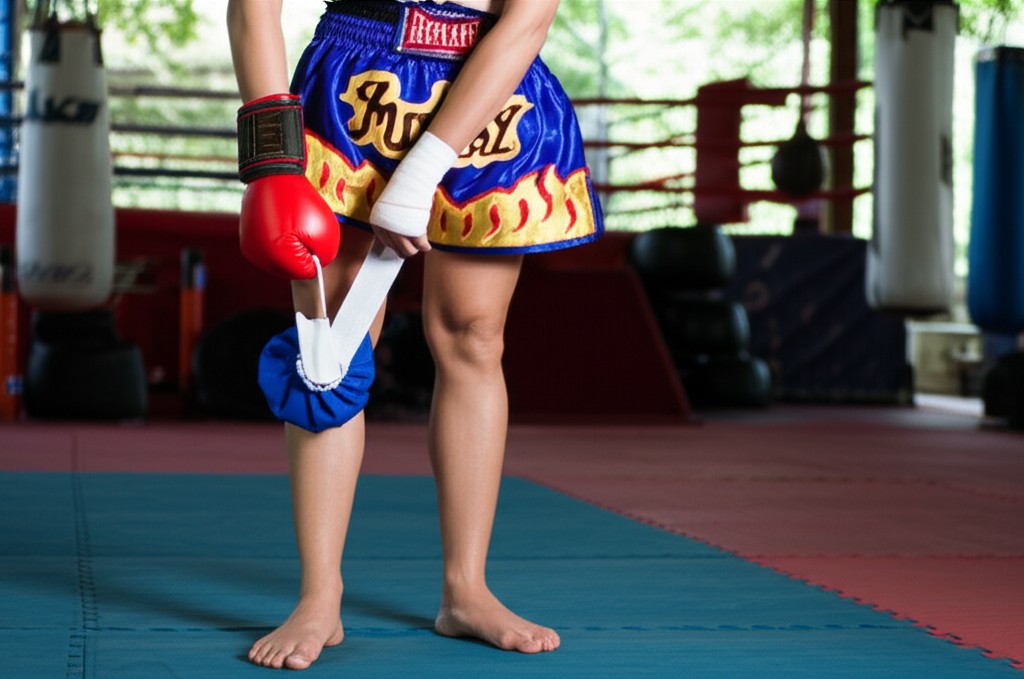
Hand wrapping is not optional — it protects the small bones of the hand and stabilises the wrist joint. Get your camp trainer to check your wrapping technique in the first few sessions. The wrap should be firm (not tight) across the knuckles, crossing behind the thumb, and covering the wrist without restricting circulation. Hit through the first two knuckles (index and middle finger), not the outer knuckles.
Treatment
Minor soreness: ice, reduced bag volume, check wrapping technique. For persistent joint pain that worsens with training: rest from bag and pad work (continue technique drilling without impact), and assess whether technique correction is needed. Significant swelling or pain that doesn't improve in 3–4 days warrants medical assessment — stress fractures require proper diagnosis to manage safely.
3. Knee Pain
What it is
Knee pain in Muay Thai training typically comes from three sources: runner's knee (patellofemoral syndrome) from the running component, lateral knee pain from low kick volume, or medial knee strain from clinch work and knee strikes. The knee joint absorbs significant rotational force during kicking — when technique is poor or the supporting muscles are weak, the joint bears load it shouldn't.
Prevention
Strengthen the muscles around the knee before high-volume kicking: quad, hamstring, and glute work. The S&C guide covers relevant exercises. Ensure proper kick mechanics — the power should come from hip rotation, not knee torque. Avoid dramatically increasing kick volume in a single session. Knee sleeves provide useful compression and warmth for those with existing sensitivity.
Treatment
Rest from high-impact kicking (pad and bag work). Continue technique drilling at reduced intensity. Ice and compression post-session. Persistent knee pain with swelling or instability requires medical assessment — don't train through a knee that gives way or locks.
4. Hip Flexor Strain
What it is
The hip flexors — the iliopsoas and rectus femoris — are heavily loaded in Muay Thai through the kicking motion and the running warm-up. Visitors who arrive with tight, undertrained hip flexors frequently develop strains within the first week of camp, typically felt as sharp or pulling pain at the front of the hip or deep in the groin during high kicks.
Prevention
Daily hip flexor stretching before the trip (see the pre-trip preparation guide) and continuing daily stretching during the camp. Warm up thoroughly before kicking — cold hip flexors are far more vulnerable to strain than properly warmed ones. Limit kick height in the first week to a level that doesn't create pulling sensation in the hip.
Treatment
Rest from high kicks for 48–72 hours. Gentle static stretching (not aggressive stretching of an acute strain — that worsens it). Anti-inflammatory medication for significant pain. The flexibility and mobility guide covers the specific stretches for hip flexor recovery.
5. Shoulder Impingement
What it is
Shoulder impingement develops from repeated overhead motion and sustained guard position — both present in Muay Thai. The rotator cuff tendons become compressed between the humeral head and the acromion, producing pain at the top of the shoulder and with overhead movements. Common in visitors who arrive with pre-existing rotator cuff tightness or weakness and then subject the shoulder to significant new volume.
Prevention
Strengthening the rotator cuff before the trip — internal and external rotation exercises with a light resistance band are sufficient. Maintain a guard position that doesn't collapse the shoulder internally: elbows should be pointed slightly outward, not pressed in against the ribcage. Avoid going to failure on punching drills — fatigue collapse in the shoulder is when impingement load is highest.
Treatment
Reduce punching volume and avoid overhead movements (including aggressive overhead stretching). Anti-inflammatory medication for acute pain. Rotator cuff strengthening exercises in the range that doesn't provoke symptoms. For impingement that doesn't improve within a week of conservative management, physiotherapy assessment is appropriate. Physio x Fitness in Phuket offers sports physiotherapy alongside training.
6. Rib Contusions
What it is
Body kicks and knee strikes to the ribs produce contusions — bruising of the bone or surrounding tissue. Rib contusions are painful, take 2–4 weeks to fully resolve, and can limit training significantly if severe. They're particularly common in sparring and unavoidable in contact work at higher intensity.
Prevention
Rib contusions are a function of contact level, not technique. The primary prevention is keeping sparring intensity appropriate to your level and stage of training. A rib guard or sparring vest (available to rent or buy at most Phuket camps) significantly reduces contusion risk during sparring.
Treatment
Rest from contact work. Deep breathing exercises to prevent respiratory complications from reduced breath volume due to pain. Anti-inflammatory medication. Ice in the first 24–48 hours, then heat. Rib contusions don't require medical management unless breathing is significantly compromised. Most resolve sufficiently to return to training in 7–10 days at reduced intensity.
General Principles for Managing Training Injuries in Phuket
Distinguish pain from soreness: Muscle soreness (DOMS) is diffuse, peaks at 24–48 hours post-training, and is symmetric. Pain is localised, may worsen during or immediately after the offending activity, and doesn't resolve on the standard DOMS timeline. Train through soreness; investigate pain.
Active rest rather than complete rest: Most minor injuries benefit from active recovery — light movement that maintains blood flow without loading the injured tissue. Complete rest slows recovery and causes fitness loss. Swimming, light yoga, and non-impact cardio can usually continue through most lower limb injuries.
Communicate with your trainer: A good trainer adjusts the session around an injury rather than ignoring it. Describing specifically what hurts and when lets them design padwork that avoids the injured movement while maintaining training volume on everything else.
Recovery tools: The standard Phuket recovery toolkit is particularly effective for injury management. Sports massage reduces muscle guarding and improves circulation around injuries. Ice baths reduce systemic inflammation. See the sports massage guide and recovery tools guide for what's available near major training areas.
The first week is the highest-risk period: Most training injuries at Phuket camps occur in the first week, before the body has adapted to the new movement patterns and training volume. The first week guide covers how to pace yourself during this highest-risk period. Caution in days one through seven pays dividends across the entire trip.