Muay Thai vs CrossFit: Which is Better for Fitness? An Honest Comparison
An honest comparison of Muay Thai vs CrossFit for fat loss, strength, cardio, skill development, injury risk, and community value.
Muay Thai and CrossFit are two of the most popular training options at Phuket's gyms, and a common question among visitors is whether to dedicate their trip to one or split time between both. They're different enough that the comparison is genuinely useful — and the answer depends almost entirely on what you're trying to achieve.
What Each Discipline Actually Is
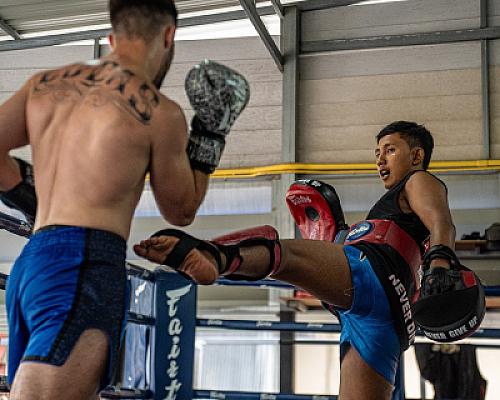
Muay Thai is a striking martial art using fists, elbows, knees, and kicks. At a Phuket training camp, a typical session involves running, skipping, technique drilling, padwork with a trainer, bag rounds, and often clinching. It's a skill-based sport with a deep learning curve — you can spend years developing technique. The fitness benefit is a byproduct of skill training rather than the primary purpose, though it's substantial.
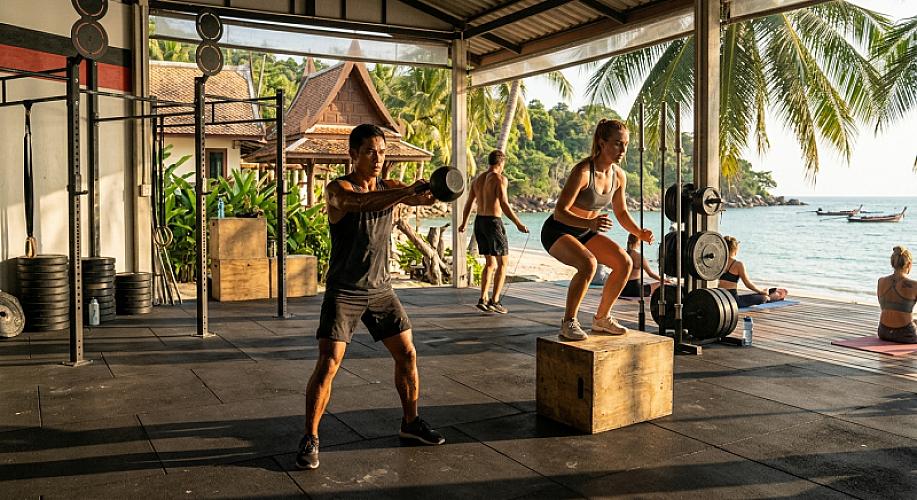
CrossFit is a high-intensity functional fitness methodology combining weightlifting, gymnastics, and metabolic conditioning in constantly varied workouts. At a Phuket CrossFit box, classes typically run 60 minutes with a structured warm-up, strength or skill component, and a metcon (metabolic conditioning workout). The primary purpose is fitness — measurable improvements in strength, power, endurance, and body composition.
The fundamental difference: Muay Thai teaches a skill that happens to produce fitness. CrossFit produces fitness without teaching a specific external skill.
Caloric Expenditure and Fat Loss
Both produce significant caloric expenditure, but through different mechanisms.
A 90-minute Muay Thai session burns 600–900 kcal for a 75kg person. The EPOC (afterburn) effect is meaningful given the high-intensity intervals of padwork and bag rounds.
A 60-minute CrossFit class burns 400–600 kcal with comparable EPOC. The shorter duration is slightly offset by the higher peak intensity of some movements (Olympic lifts, max-effort sprint intervals).
For pure caloric burn per session, Muay Thai has an advantage due to session length. Over a training week with twice-daily Muay Thai versus once-daily CrossFit, the gap is significant. See the Muay Thai weight loss guide for realistic outcomes from camp training specifically.
Verdict: Muay Thai for total caloric expenditure and fat loss over a training trip.
Strength and Muscle Development
CrossFit wins clearly here. The programming explicitly develops muscular strength through barbell work (squats, deadlifts, cleans, presses) and gymnastics movements (pull-ups, handstands, ring work). A consistent CrossFitter develops measurable strength across multiple planes of movement.
Muay Thai develops functional strength in specific patterns — leg power for kicking, shoulder endurance for guard work, core stability for rotation — but doesn't systematically develop maximum strength. Many experienced Muay Thai fighters supplement their striking training with strength and conditioning work for exactly this reason. The S&C for Muay Thai guide covers how to add this effectively.
Verdict: CrossFit for strength and structured muscle development.
Cardiovascular Fitness
Both develop cardiovascular fitness, but in different energy systems.
Muay Thai develops both aerobic capacity (from the volume of continuous work across long sessions) and anaerobic capacity (from the high-intensity intervals of padwork rounds). The twice-daily structure compounds this significantly.
CrossFit's constantly varied metcons are specifically designed to target multiple cardiovascular pathways. A well-programmed CrossFit box will systematically develop VO2 max, lactate threshold, and aerobic base across a training week.
Both are excellent cardiovascular training. Muay Thai at high volume (twice daily) edges ahead purely on time-in-work. CrossFit is more systematically programmed to target specific cardiovascular adaptations.
Verdict: Draw — both develop cardiovascular fitness effectively, through different methods.
Skill Acquisition
This is Muay Thai's clearest advantage. Learning a martial art is a qualitatively different experience from fitness training — you're developing a capability that exists independent of the gym, can be used (defensively or competitively), and continues to develop for years. Many people describe the skill acquisition component as the most rewarding aspect of a Phuket training trip.
CrossFit does develop skills — particularly Olympic lifting technique and gymnastics movements — but these are primarily tools for fitness training rather than standalone capabilities. The combat sports comparison guide explores this skill-acquisition dimension across different martial arts if you're weighing options.
Verdict: Muay Thai for meaningful skill acquisition.
Injury Risk
Both disciplines carry injury risk, but the nature differs.
Muay Thai's risks are contact-related: bruised shins from bag work and kicking, facial contact from sparring, wrist and hand injuries from improper bag technique, and knee strain from kicking volume. These are mostly manageable with proper technique, appropriate protective equipment, and progressing contact work gradually.
CrossFit's injury risks are largely movement-related: lower back injuries from poor deadlift and Olympic lift form, shoulder injuries from overhead work, and overuse injuries from high-repetition movements. Injury rates in CrossFit are real, though comparable to other training modalities when coached properly and when athletes are honest about their current capacity.
For a first-time visitor with no existing training background, Muay Thai in a camp setting (where technique is taught carefully) is arguably safer than CrossFit, where the self-directed intensity can override form. Experienced CrossFitters transitioning to a Phuket box will have a different experience.
Verdict: Comparable, with different risk profiles.
Community and Social Experience
Both disciplines have strong communities, but Muay Thai's camp structure creates something distinctive. Living and training with the same group daily, sharing the difficulty of twice-daily training, and building relationships with Thai trainers creates a social depth that a one-hour CrossFit class rarely matches. This is particularly relevant for solo travellers — see the solo fitness travel guide for how the community dimension works.
CrossFit boxes have excellent communities in their own right, and the Phuket CrossFit scene has established regulars and drop-in culture that's welcoming to visitors. But the time-limited class format doesn't generate the same bond as a full-day camp environment.
Verdict: Muay Thai for depth of community on a training trip.
Which Should You Choose in Phuket?
Choose Muay Thai if:
- Learning a new skill is part of the appeal
- Fat loss and cardiovascular fitness are primary goals
- You want the full camp experience — twice daily training, trainer relationships, a structured programme
- You've never done Muay Thai and are curious about it
- You're staying two weeks or more and want the immersive experience
Choose CrossFit if:
- You're an experienced CrossFitter who wants to maintain your training routine while travelling
- Strength development is a primary goal and you don't want to deprioritise it
- You prefer a structured fitness programme over a martial arts learning environment
- You're on a shorter trip and want a familiar training environment with predictable results
Do both if:
- You're staying three weeks or more
- You want the skill of Muay Thai plus the structured strength development of CrossFit
- You have the recovery capacity — which means excellent sleep, nutrition, and massage between sessions
The combination of Muay Thai in the morning and CrossFit two or three afternoons per week (replacing Muay Thai afternoon sessions) is a legitimate training approach for experienced athletes on longer trips. It's demanding but produces comprehensive fitness results alongside genuine Muay Thai development.
Browse Phuket's CrossFit boxes and HIIT and functional fitness gyms to compare options alongside the Muay Thai camp landscape.
The RoamFit editorial team researches and maintains Thailand's fitness directory. We combine verified Google data, on-the-ground knowledge of gyms, Muay Thai camps and studios, and hands-on testing to help expats, health tourists and locals train anywhere in the country. Every guide is fact-checked against the listings in our directory.